
By Jasmine Stark, Editor
Through our first year in print, Monroe Matters has grown, changed, and learned a great deal.
Growth of Our Team
Over the past year we have added many local writers to our team like Max Nickel, who started writing with us last year as a Jr. Reporter while attending Mary Persons High School and continues to write for us after graduating. Our newest writer, Tiffany Larrabee has also taken on the role of advertising salesperson.
Several writers have taken to writing regular columns or serial articles including Lisa Schumacher with her monthly Mental Health Minutes, Christina Bramlett who provides us with important safety info in our public safety corner column, and Mark d’Agostino who wrote a four-part piece on zoning in Henry County vs Monroe.
If I named all of the amazing writers who have shared their voice with our readers, I would quickly run out of room but we are grateful for each and every one of them.
At the beginning of 2025, Monroe Matters also hired a new editor, Jasmine Stark, who has taken over many of the roles required to plan and execute our monthly issues including strategic planning, editing articles, selling ad space, designing the layout, interviewing sources, writing stories, and distributing the printed copies. Stark does whatever is needed to get our issues into your hands.
Changes to Format and Internal Processes
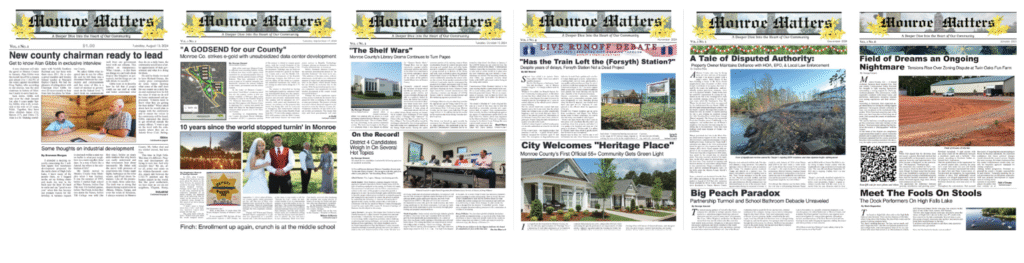
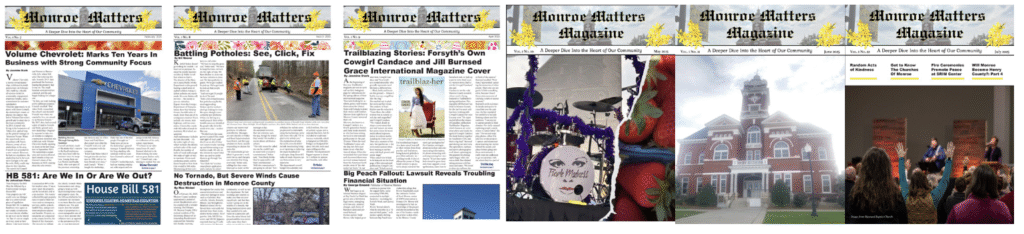
Since our first issue in August of 2024, Monroe Matters has gone through several transformations. Though our mission and values have remained the same, our format has changed multiple times, and we have built internal systems and processes that make it easier for us to grow our team.
Our first issue used a short tabloid format which was a great starting point, but we quickly switched to a longer tabloid and then broadsheet format to allow for more and larger stories.
In May, after we had several people suggest the idea, we made a big switch to our current magazine format. One key reason we made this switch was that we felt our focus on positive, community-led stories fit better with this form of print media than traditional newsprint. Some extra bonuses that came from this switch include higher quality photos, more layout design options, and the attraction of a broader audience. So far, our readers’ response to this switch has been extremely positive.
Our editor has created several internal systems and processes for taking on new writers who are paid on an article-by-article basis, and advertising salespeople who are paid on commission. Every new team member is valuable to us, and the more help we have, the higher quality content we can provide to our readers.
Lessons Learned
In recent months, we’ve learned a lot about the financial realities of growth. Taking on more team members comes with extra costs, and switching to a magazine format more than doubled our per-copy print costs, prompting us to reduce our distribution numbers.
Our initial research suggested that a higher-quality print format would increase reader engagement, allowing us to maintain value for advertisers even with a smaller distribution. While that may still be true, we’ve realized the importance of being able to clearly measure and demonstrate that engagement.
We also explored subscriptions as a new revenue stream, but high mailing costs and slower growth have shown us that it’s not a viable solution—for now. Advertising remains our primary income source, and it’s where we see the most opportunity for growth.
The shift to a magazine format has also taught us a great deal about advertiser expectations and the need for measurable results and clear engagement. In response, we’re making significant changes to how we approach advertising—prioritizing strategies that boost engagement, provide transparent tracking, and support our advertisers in connecting their print campaigns with broader marketing and community outreach efforts.